
U is for Understanding the World: The ABC of Nursery Management
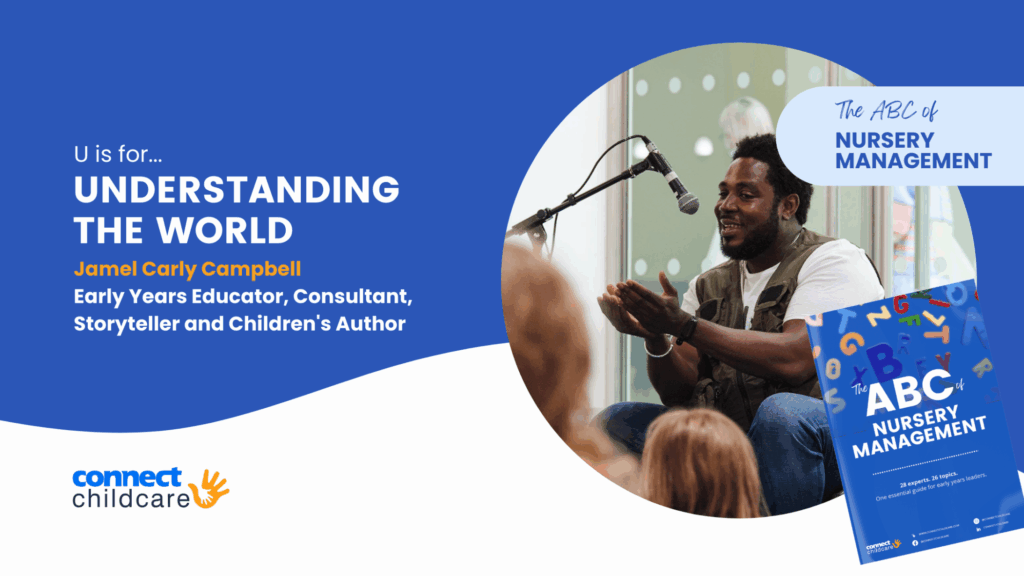
This article is taken from our 2025 edition of the ABC of Nursery Management guide. You can explore more topics and expert insights by downloading your copy here.
U is for understanding the world through storytelling
My earliest memories of storytelling come from the stories read to me by my mother before bedtime. She would read from books that only had one or two illustrations, which in turn helped to broaden my imagination, and I would create the different scenes and scenarios in my head as she read to me.
Throughout my life, my father would tell me about his upbringing in the 60’s, about adventures that he embarked on with his friends and his siblings, when they played out as children or about old times and memories playing music with his Sound system collective.
I have fond memories of stories told to me by my nanny, granny and other elders in my family, telling me about how life was in the Caribbean and about their journey to England during the Windrush period. One thing that stood out to me was the tones in their voice and the flow of each story. Each story had its twists and turns, with sections of laughter and silence which helped to clearly articulate and express emotion or create suspense, which helped keep my attention. The language they used switched from English to Jamaican Patois or Trinidad and Tobagonian patois or Creole, which would give the stories that authentic, traditional feel.
These wholesome experiences are the key influences on the way I tell stories. Do you have any key influences or childhood memories of storytelling?
His-story of storytelling
Stories were used as a means of sharing information and passing on memories from times past. In Africa and the West Indies/Caribbean, stories were used as a means of teaching and sharing morals or lessons of life. Communities or families would sit outside in a circle and listen to elders telling stories about people they’ve encountered, animals or insects (known as Anancy stories). Some of the stories were based on their lives, while others were considered folktales or fables.
Parables were also told, more commonly known as stories told by Jesus in the Bible, but used in the same way. Stories like the ‘PRODIGAL SON’ or ‘THE GOOD SAMARITAN’. Other religions also have their ways of teaching lessons of life and spirituality.
Many folk stories, tales and history were lost because initially these stories were told and passed on by word of mouth and as generations passed on the stories went with them. Eventually, the stories that remained and were remembered were written down and stored in libraries or sacred places such as libraries in Timbuctoo and Ancient Kemet, but many were lost, destroyed and looted due to war or countries being conquered. These actions were used as a means of control and erasing history.
“A people without the knowledge of their past history, origin and culture is like a tree without roots”. – Marcus Gavey
Structure and components of stories
In order to tell or teach others to tell stories through different mediums, written, verbal, role play, etc, our staff, facilitators, educators and our children need to understand the structure of stories. Stories may have a beginning, middle and end. With an ongoing theme or thread of events that lead to a conclusion, good or bad. Stories may have characters, fictional or non-fictional, they may have an antagonist, a protagonist and side characters that all play a role, major or small. Reassure your staff that it’s fine for stories not to have an ending or conclusion, and some stories may not have characters, but maybe be based on an object or plant. Some stories do not have dialogue or words, verbal or written, but music that illustrates feeling. Some stories may be based on a series of motions or movements as seen in stop and start animations or sped up films, e.g. the development of a building or the lifecycle of a butterfly.
In our settings
In education and early years settings, most adult-to-child storytelling happens during circle time, carpet time, or lesson time. The children usually sit in a circle, either on designated spots on a carpet, in the book corner, or at a table or desk. If the children are on the carpet, the teacher typically sits on a chair. For storytelling at a table or desk, the teacher may sit or stand nearby, depending on whether they’re reading to an individual child or a group.
Provocation
Managers, where does storytelling take place in your setting? Do you encourage your team to take storytelling beyond the usual spaces like the carpet area, book corner, or tables and desks? Are children encouraged to create and share their own stories, perhaps during circle time? Do your staff use a variety of media or technology to bring stories to life?
What is your preferred method of storytelling?
- As educators and storytellers, we have a wide range of storytelling approaches to choose from. Yet, we often stick to the comfort of books—wonderful as they are—while overlooking the many other tools available to us. To make the most of these tools, we first need to understand what they are and how they can be used.
- Written Stories: These are stories read from books, printed text, or ones written by the educator or created together with the class using paper and pen.
- Oral Storytelling: The oldest form of storytelling, simply sharing stories by speaking, singing, or chanting. It often includes expressive voices, gestures, and facial expressions to build suspense and keep children engaged.
- Interactive Storytelling: This approach involves the audience in the story. Children might be asked to make a choice, answer questions, repeat phrases, make sounds, or help decide how the story ends. Role play is also a great example, where children use small world play, dressing up, and props to act out stories.
- Visual Storytelling: Stories told using images, objects, props, or illustrations. Educators might use objects of reference, photos, Velcro books, felt boards, tablets, projectors, or interactive whiteboards—often supported by narration.
- Digital & Transmedia Storytelling: This includes using digital tools like videos, images, or animations to tell stories. These can be shared on apps or social media platforms, offering children a modern and engaging way to create and experience stories.
‘Let’s make our story times more interesting’
The beauty of storytelling is understanding that each storytelling medium can crossover, please encourage your staff to combine methods to create a stimulating and fully engaging story time.
I use all types of storytelling methods, but my go-to methods of storytelling, especially when reading to children in early years settings, are Dialogical storytelling and Helicopter storytelling.
Helicopter Stories: Educators will create a safe space for children to play cooperatively, drawing pictures, writing simple sentences to create and share a short story. The group will sit down, and a stage will be created, and the children will take turns to tell, act, use props or dress up to bring their stories to life.
Dialogic storytelling: Educators will encourage the children to interact by asking questions and holding discussions about themes in the story or book. This approach encourages the use of critical thinking, extends knowledge, encourages children to engage in conversation, stick to a theme and helps to develop language and turn-taking.
7 things to consider when storytelling
Storytelling is a powerful tool in early years and education settings, but to make it meaningful, there are a few important things we should keep in mind:
- Know your audience
Is the story, and the way it’s being told, suitable for the children listening? Think about their age, attention span, language development, and ability to engage and understand.
- Children’s relationships with stories
How do the children in your setting currently relate to books and storytelling? Are they enthusiastic, curious, or hesitant? Think about ways to encourage a love for stories, through variety, routine, or giving children a choice in what’s read.
- Staff confidence and engagement
What is your team’s relationship with storytelling? Do they feel confident and inspired to lead story sessions? Support and encourage staff to take part, share their favourite stories, or explore new ways to tell them.
- Diversity in stories
Look closely at your book collection and the stories you tell. Do they reflect a diverse range of cultures, experiences, languages, and families? Children should be able to see themselves and others represented in stories.
- Try different methods
Everyone has their own storytelling style. Be open to experimenting with different methods, oral, visual, digital, interactive, and find what works best for you and your group. Don’t be afraid to step out of your comfort zone.
- Children’s voice and agency
Give children the chance to be part of the storytelling process. Let them choose books, add ideas to a story, or tell their own stories. This builds confidence, language skills, and a sense of belonging.
- Keep engagement high
Use your voice creatively, change your tone, add sound effects, and bring props or pictures. Try story boxes, sensory items, songs, or interactive buttons. Small changes can make a big impact on engagement.
Everyone has a story to share, our staff, children and their families alike and it’s important that as managers and educators we create a safe space and provide the relevant resources in the environment for these stories to be formed and shared. Let’s create a space for our community to tell his-story.
Jamel’s first picture book, Olu’s Teacher: A Story About Starting Nursery, illustrated by Lydia Mba, supports children as they transition into nursery. You can find it here.
The ABC of Nursery Management 2025 | FREE Download
Share this article

About the Author
Jamel C Campbell is an Early Years educator, consultant, storyteller, and bestselling author with over 20 years’ experience. A Men in the Early Years ambassador, he’s featured on CBeebies’ Tiny Happy People and works with major organisations to champion inclusive practice, storytelling, and children’s development from birth to 19.
Latest Posts
 Connect Childcare Partners with Nuuri to Support Parent Enquiries
 The Childhood Obesity Crisis: How Early Years Settings Can Make a Difference
 Supporting Confident Beginnings: Using the National Induction Resource in Early Learning and Childcare
Newsletter sign up
Get all the latest Connect news and updates to your inbox.